
The Question We Kept Hearing
“How do I use AI?”
That question, typed in a DM rather than asked out loud, told us everything. Our design team was not short on curiosity. What was missing was somewhere to be a beginner. A space where not knowing wasn’t a liability, but the whole point. So we built one. In true Slack fashion, our AI origin story starts with a Slack channel and a lot of enthusiasm.
Back in early 2025, the vibe was exploratory. AI felt like something cool on the horizon, a new tool worth poking at. We kicked off a channel, secured some vibe tool training for anyone who wanted it, and ran a few sessions. The energy was “take it for a spin.” Low stakes, high curiosity. Very Slack Design.
Then 2026 happened.
Suddenly AI wasn’t a future thing. It was a right now thing. Engineers were moving fast, really fast. Designers needed to start moving with them, not after them. That’s where Builder Days came into play: three days where designers, engineers, and product managers would set aside their roadmaps and just build together with AI. The mood shifted from curiosity to something with a little more urgency: we need to be ready for this.
As a Design Ops person with a soft spot for learning programs and the human side of change, I saw a chance to help. Not to mandate anything, but to create the space where curious designers could get genuinely, practically ready. to show up to Builder Days with something to contribute, not just something to observe.
This is that story. What we did, what we learned, what surprised us, and what we’d tell any design team trying to figure out where they fit when everything starts moving at once.
For Design, By Design
The problem wasn’t a shortage of learning opportunities. It was the opposite. Tool enablement sessions started flooding our calendars from every direction, and almost none of them were built with designers in mind. Most of these sessions were designed for engineers, and we were just along for the ride. There was another wrinkle: things were moving so fast that a setup guide from Monday was outdated by Friday.
So we decided to build our own AI enablement programming. For design, by design.
That phrase became our north star. Hearing what AI tools can do from a fellow designer lands completely differently than hearing it from an engineer. It wasn’t evangelism. It was permission, and for the designers on our team who were still waiting to be convinced, that distinction mattered more than we expected.
Our sessions weren’t polished. And honestly? That was the point.
We ran a Friday series called Designers Who Vibe & AI, and the most memorable moments weren’t the prepared demos. They happened when someone interrupted to ask a question, shared their screen (tabs and all), and we’d just figure it out together in real time. No scripts. Just curiosity out loud.
We were learning something that was changing faster than any guide could keep up with. So instead of pretending we had all the answers, we leaned into the one thing that actually worked: ask the question, try the thing, and when you get stuck, ask AI.
Let AI teach you how to use AI. That became one of our mantras.
Three Days. No Roadmap. Just Build.
Builder Days were designed to be intentionally open-ended. Show up, find your cross-functional partners, and build something with AI. Simple in concept, but harder in practice, especially when both the technology and the collaboration model are new at the same time.
So we helped designers come prepared. We highlighted how other designers were thinking about their approach, so no one had to figure it out alone. We created a “Designer’s Guide to Builder Days,” a one-stop resource for what to expect, what was expected of you, and where to find inspiration. It also included a terminology section for anyone who needed a jargon-free answer to “Wait, what’s a terminal?”
We also reframed what success looked like. The purpose of Builder Days wasn’t to make AI work for you: it was to learn when it does and when it doesn’t. Finding the edges was the point.We even created a temporary support channel just for Builder Days. If you got stuck, you asked, and someone from the team would help. No judgment, no friction.
And when one designer, deep into a frustrating loop of prompts, finally admitted they just wanted to touch grass, we counted that as a finding too. At the end of the day, we’re still human, and we can’t lose sight of that.
Before Builder Days, learning was happening in pockets. Builder Days forced something different and what we saw was messy and energizing in equal measure. Designers who’d been lurking suddenly had a forcing function, and teams circling AI integration for months had no choice but to try it. Some things broke, and a lot of things surprised people in a good way.
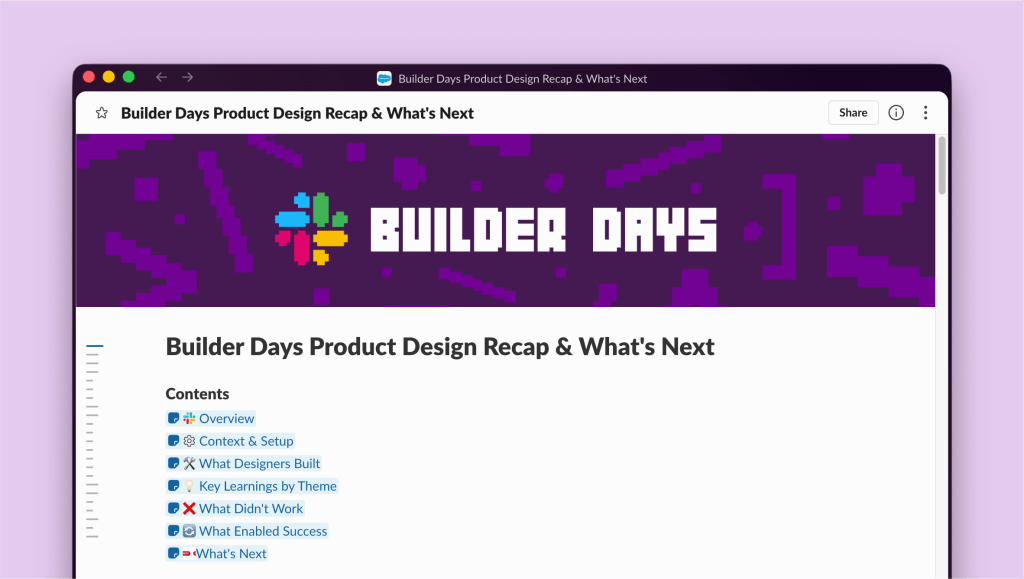
But the real learning happened after Builder Days.We brought together a handful of designers who’d had mixed experiences and asked what they actually learned. The answers were honest and spicy in the best way.
- Human judgement is a non-negotiable: The speed of AI output demands a corresponding increase in coordination, communication, and human oversight — not less.
- Upfront planning is everything: The teams that thrived had a clear plan from day one — defined ownership, a shared working model, and early, frequent progress sharing.
- The harness matters as much as the model: A great model alone isn’t enough. Investing in the “harness” — prompts, claude.md, skills, and documentation — is what unlocks product-quality AI output.
- Collaboration models are shifting: AI shifts collaboration from optimizing async work to spending more time on meaningful, high-value activities: decisions, brainstorming, and shared ideation.
One designer spent her three days trying to understand her own relationship with AI. Not building something to show, not optimizing a workflow, simply just sitting with it and asking it hard questions. Her conclusion? “It’s complicated.”
And you know what? That’s okay. That’s also a really good finding. Not every designer walked away with a working prototype or a merged PR. Some walked away with something harder to measure and more important: a clearer sense of where they currently stand with this technology, what excites them, what makes them uneasy, and what questions they still need to answer for themselves.
That’s the thing about building a learning culture: the value isn’t always in the output. Sometimes it’s in the container. When people know there’s a place to bring their confusion, they bring it. And when confusion is visible, it becomes something the whole team can work on together.
Start With the Community
We’re still in the middle of this. Builder Days just ended. The channel is still buzzing. Our AI programming will keep evolving based on what the team actually needs. But if we could pass one thing on to another design team, it’s this: don’t start with the tools, start with the people. Find your beginners. Give them a place to be curious without embarrassment. Put them next to someone who’s one step ahead, not ten. And give the whole team enough protected time to practice together.
The tools will keep changing, but the culture you build around learning them is what compounds. And as someone whose job is to clear the path for designers, I met this AI moment the only way I know how to approach a program: start with the people.